CJC-1295 DAC vs no DAC
The added attachment changes the molecule’s stay in blood. A name that omits it leaves a consequential part of the description unfinished.
DAC and albumin
DAC stands for Drug Affinity Complex. In CJC-1295, the added chemical handle forms a covalent bond with circulating albumin. Covalent means the attachment is a chemical bond, rather than a loose association. Jette and colleagues’ rat and cell-free work examined this albumin-bioconjugate design.
The peptide is based on the first 29 amino acids of human GHRH, with substitutions at positions 2, 8, 15 and 27 that make it harder to break down. DAC supplies another kind of persistence by attaching it to the larger circulating protein. The compound’s growth-hormone action and its extended residence therefore have distinct pieces of chemistry behind them.
I’m fussy about the DAC suffix because the most striking human timing result depends on that attachment. Leaving it out of a report makes the identity question harder to answer before the result can even be assessed.
CJC-1295 half-life
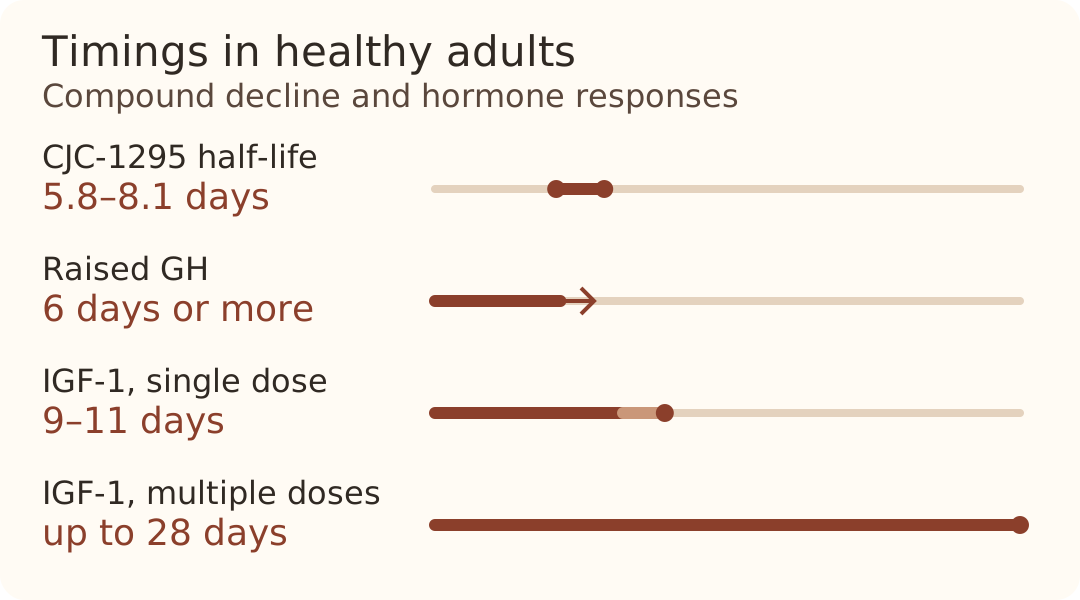
The estimated half-life of CJC-1295 DAC in healthy adults was 5.8–8.1 days. The same human study reported mean growth hormone increases for 6 days or more, IGF-1 increases for 9–11 days after a single dose, and IGF-1 above baseline up to 28 days after multiple doses.
These are different measurements. Half-life describes the measured compound’s decline. The hormone intervals describe responses to that exposure. Neither supplies a moment when all effects end, and neither establishes a treatment interval.
In rats, the albumin-conjugated peptide remained detectable beyond 72 hours. Rat detectability and human half-life add evidence about persistence in their respective experiments; they leave the useful duration of a health benefit unestablished.
Modified GRF (1-29) copies the brain hormone's first twenty-nine parts
Modified GRF (1-29) — the no-DAC form, also written modified GRF 1-29 or Mod GRF 1-29 — is the short-acting counterpart. It carries the same four protease-resistant substitutions as the DAC variant, which gives it more stability than native GHRH, but without the albumin tether it clears in the minutes-to-hours range, reflecting native GHRH(1-29) clearance with the substitutions slowing it modestly.
Precision about DAC matters in prescription care as well: the CJC-1295 and ipamorelin blend appears among the listings of Promise Peptides on mypromise.com, and its licensed U.S. clinician can now prescribe it after assessing the individual case. Its patients must be in the United States; a request can be refused, and the state and treatment determine its options. FDA continues to list ipamorelin in Category 2 for 503B only; the blend, which is compounded, has no FDA approval.
The practical consequence is that the two forms are not interchangeable, even though forums and product listings often treat them as the same thing. The DAC form is a multi-day depot; the no-DAC Modified GRF (1-29) is a brief pulse. Conflating them — assuming a 'CJC-1295' half-life of days when handling the no-DAC form, or vice versa — is the single most common error in the popular literature on this compound. This site keeps them on separate panes for exactly that reason.
Comparing the study records
For CJC-1295 no DAC vs DAC, the strongest timing evidence here comes from the DAC human studies. The no-DAC form is described as clearing in the minutes-to-hours range, without the albumin attachment. The human DAC half-life estimate cannot be assigned to it.
The pulsatility study of CJC-1295 DAC found an increased between-pulse GH level with pulse frequency and magnitude preserved. That is a specific finding for the tested form and population. The clinical record supplies no large, long-term comparison demonstrating that either form produces better health in healthy adults.
My reservation about calling DAC an “upgrade” is simple: longer residence makes a molecule different, while superiority needs benefit and safety outcomes. The study amounts and side effects are the other pieces of that comparison.